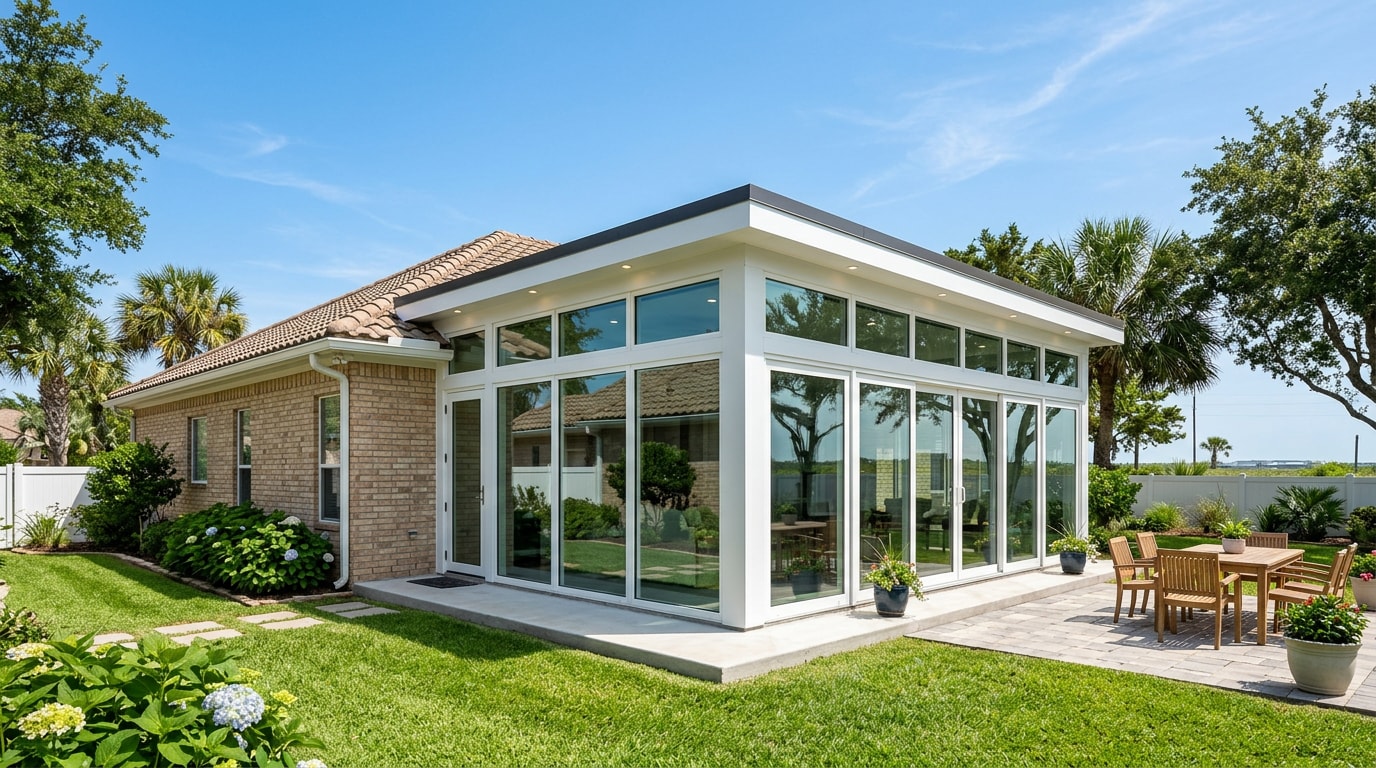
A glass room extension in Portland, TX sits somewhere between a traditional sunroom and a fully glazed solarium, and the right choice depends on how you plan to use the space. Gulf Coast wind, humidity, and permitting rules change the math compared to inland builds. This guide breaks down 2026 pricing, coastal construction factors, and what the build process actually looks like before you call a contractor.
What Is a Sunroom? (Glass Room vs. Sunroom Explained)
A sunroom is an enclosed living space attached to a home that uses large expanses of window or glass to bring in natural light, typically built as a home addition rather than a standalone structure. A glass room extension sits at the high end of that spectrum, favoring floor-to-ceiling glass panels over traditional framed walls for a more open, glass-enclosed living space.
The terms overlap. "Glass room" usually signals a more architectural, all-glass design. "Sunroom" can describe anything from a screened porch upgrade to a fully insulated addition. Either way, the goal is the same: extra square footage that feels connected to the outdoors without sacrificing comfort.
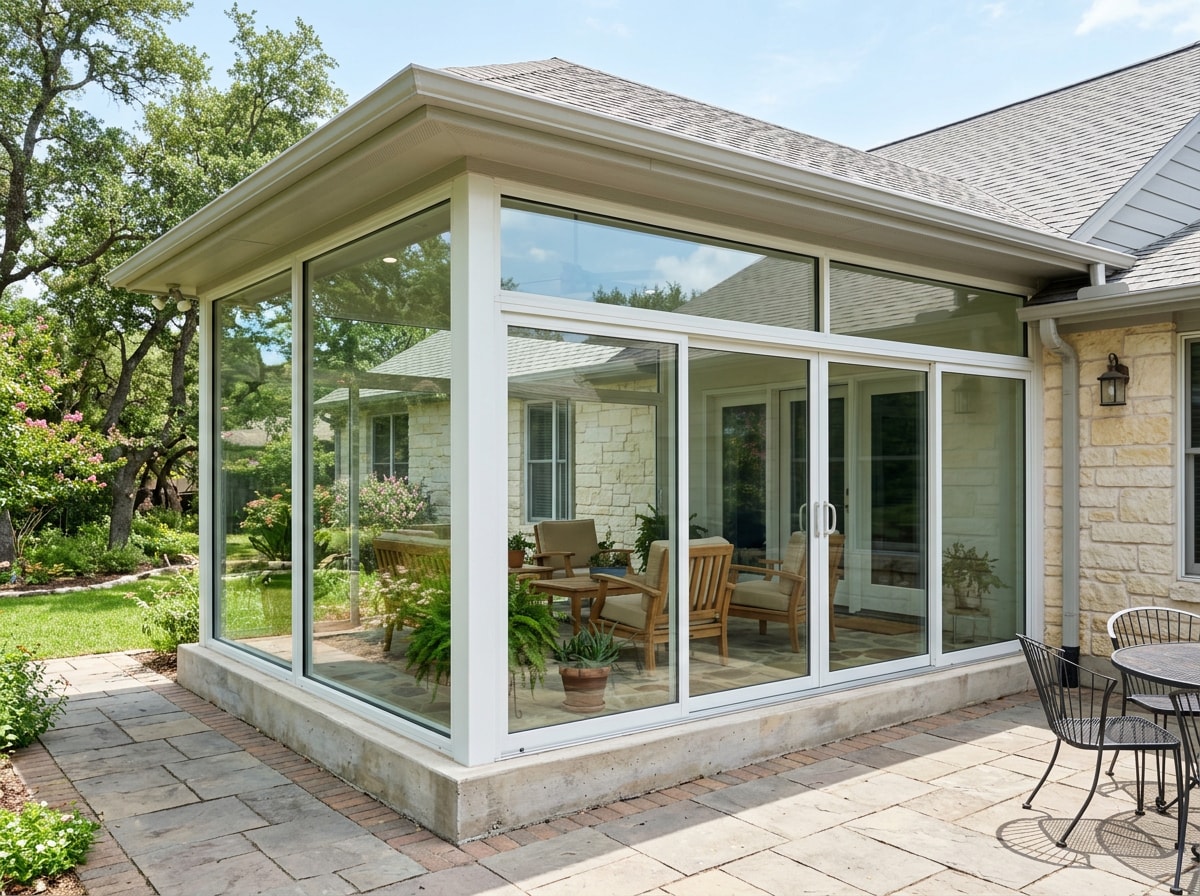
Glass quality and door hardware matter as much as the framing on a coastal build. Our windows and doors services page covers the glazing and door options we install on Gulf Coast additions.
How Much Does a Glass Room Extension Cost in Portland, TX?
National cost-guide data puts a typical sunroom addition at $22,000 to $75,000, with industry averages around $150 per square foot and high‑end builds reaching $300 per square foot, depending on size, materials, insulation and design . Texas-specific averages from these same aggregators run lower for basic builds but climb fast once a project moves toward full glass walls: one 2026 pricing tool puts the typical Texas range at $19,008 to $30,888, with an average cost of $23,760 for a standard sunroom, while another source lists the Texas state range as $9,300 low, $23,250 average, and $46,500 high .
Glass-atrium and solarium-style builds, the closest match to a true "glass room," push well past those averages because of structural glazing and reinforced framing. Treat any single number as a starting point, not a quote; your actual project should be priced after a site visit.
Basic Sunroom vs. Legal Living Space
A basic sunroom is often a three-season room: insulated enough for spring, summer, and fall but not built to handle extreme heat or cold without extra HVAC work. A legal living space addition, by contrast, is fully permitted, tied into your home's heating and cooling system, and counted as finished square footage on your appraisal.
That distinction matters more than it might seem.
- A three-season room is faster and cheaper to build since it skips full insulation and ductwork.
- A legal addition costs more upfront but typically adds more resale value, since it expands your home's livable footprint rather than adding a bonus space.
Cost by Sunroom/Glass Room Type
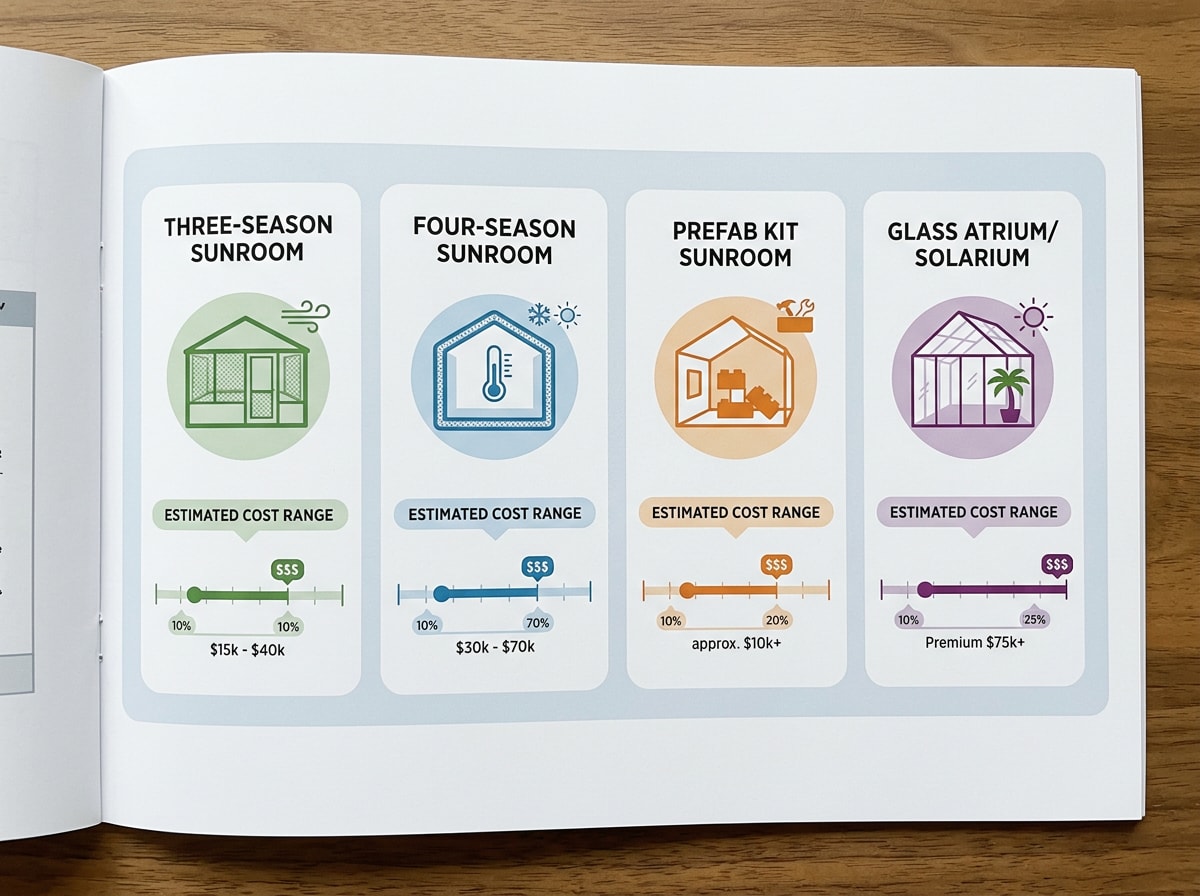
Pricing varies widely by category. A 2026 cost reference table shows the following typical ranges:
| Sunroom / Glass Room Type | Typical Cost Range |
|---|---|
| Screen room / porch enclosure (200 sq ft) | $4,000 – $10,000 |
| 3-season prefab sunroom (150 sq ft) | $8,000 – $16,000 |
| 3-season custom sunroom (200 sq ft) | $15,000 – $28,000 |
| 4-season prefab sunroom (200 sq ft) | $20,000 – $35,000 |
| 4-season custom sunroom (250 sq ft) | $30,000 – $55,000 |
| Solarium (all-glass, custom) | $30,000 – $75,000 |
This 2026 reference table lists screen room enclosures from $4,000 to $10,000 up through custom all-glass solariums from $30,000 to $75,000 . For context, another national guide puts the Texas state average sunroom cost at $43,500 , which lands right in the middle of the custom four-season and solarium categories above. A four-season sunroom with full glass walls sits at the intersection of these categories and should be priced individually based on your home's layout.
Additional Cost Factors
Beyond room type, several variables move the price up or down:
- Size and roofline complexity — larger footprints and custom rooflines add labor and material cost.
- Foundation cost — a slab-on-grade addition is usually cheaper than one requiring piers or extensive site grading.
- Glass quality — energy-efficient, impact-rated glass costs more upfront but holds up better in Gulf storms.
- HVAC integration — four-season functionality requires extending or adding ductwork and equipment.
- Permitting and design fees — professional plans and engineering add to the total, especially for wind-rated assemblies.
Most municipalities, including those along the Texas coast, require a building permit for any addition that changes your home's footprint or electrical/HVAC systems. The International Code Council advises homeowners to discuss their plans with the local code official before construction begins to confirm whether a permit is required , and skipping that step can create problems at resale. Permit fees themselves are typically modest: HomeAdvisor estimates permitting costs from $250 to $1,500 on top of material and labor.
Sunroom Cost by Location (Texas & Portland, TX Pricing)
Statewide Texas averages don't tell the full story for coastal homeowners. Portland sits in San Patricio County, one of the Texas Gulf Coast's designated windstorm catastrophe areas, which means heavier framing, impact-rated glass, and additional structural review compared to a similar project inland.
Here's the detail most generic cost guides skip entirely: Texas Department of Insurance windstorm rules cover 14 first-tier coastal counties, including Aransas, Brazoria, Calhoun, Cameron, Chambers, Galveston, Jefferson, Kenedy, Kleberg, Matagorda, Nueces, Refugio, San Patricio, and Willacy , and adding a room or garage to a coastal home generally requires that same windstorm certification . That means a Portland glass room addition isn't just a framing and glass decision, it's also a compliance step your contractor needs to plan for from day one.
If you want a broader picture of how much construction activity is happening along the coast, the U.S. Census Bureau's Building Permits Survey provides national, state, and local statistics on the number and valuation of new privately-owned housing units authorized by building permits , giving homeowners a public benchmark for permitting volume in their county.
Our Portland, TX and Corpus Christi, TX area pages outline the communities where we actively build, including Flour Bluff and Calallen.
Sunroom Addition vs. ADU vs. Outdoor Living Space
Not every extra square foot needs to come from a sunroom. An ADU (accessory dwelling unit) offers independent living space, often with its own kitchen and bathroom, but comes with higher permitting complexity and construction costs, frequently $100,000 or more. An outdoor living space, like a covered patio or pergola, costs far less but offers no climate control and limited resale impact as finished square footage.
A glass room extension lands in the middle. It's the better pick for homeowners who want year-round usable space without the cost or complexity of a full ADU, and it typically adds more appraised value per dollar than an open-air patio while costing less and permitting faster than a detached unit.
If you already have a covered porch, converting it is usually cheaper than starting from scratch. Our guide to porch conversions in Portland, TX walks through that lower-cost path to year-round space.
Glass Room Builder Serving Portland, TX & the Texas Gulf Coast
Building for the Gulf Coast means designing for wind, salt air, and humidity from day one, not treating them as afterthoughts. A qualified Portland, TX glass room builder should specify double-pane, wind-rated glass and corrosion-resistant hardware as standard, not upgrades.
On recent walkthroughs in and around Portland, we've found that many existing patio slabs are undersized for a full glass enclosure and need additional footings before glazing can go in safely, an issue that rarely shows up until someone actually inspects the site. Working with a builder based in the Texas Gulf Coast region, rather than a national franchise, often means faster response times, familiarity with local wind-zone codes, and a crew that has already solved the specific challenges coastal construction presents.
Revitalizing Renovations is a design-build remodeling company serving the Coastal Bend, and our window replacement and exterior door installation services are part of nearly every glass room project we build in this climate. Check our area pages for Flour Bluff, TX and Calallen, TX to confirm coverage near you.
Sunroom Design Ideas
Once budget and structure are settled, design is where a glass room starts to feel like part of the home rather than an add-on. Style choices should complement the existing architecture while accounting for coastal light and heat exposure.
Craftsman-Style Sunrooms
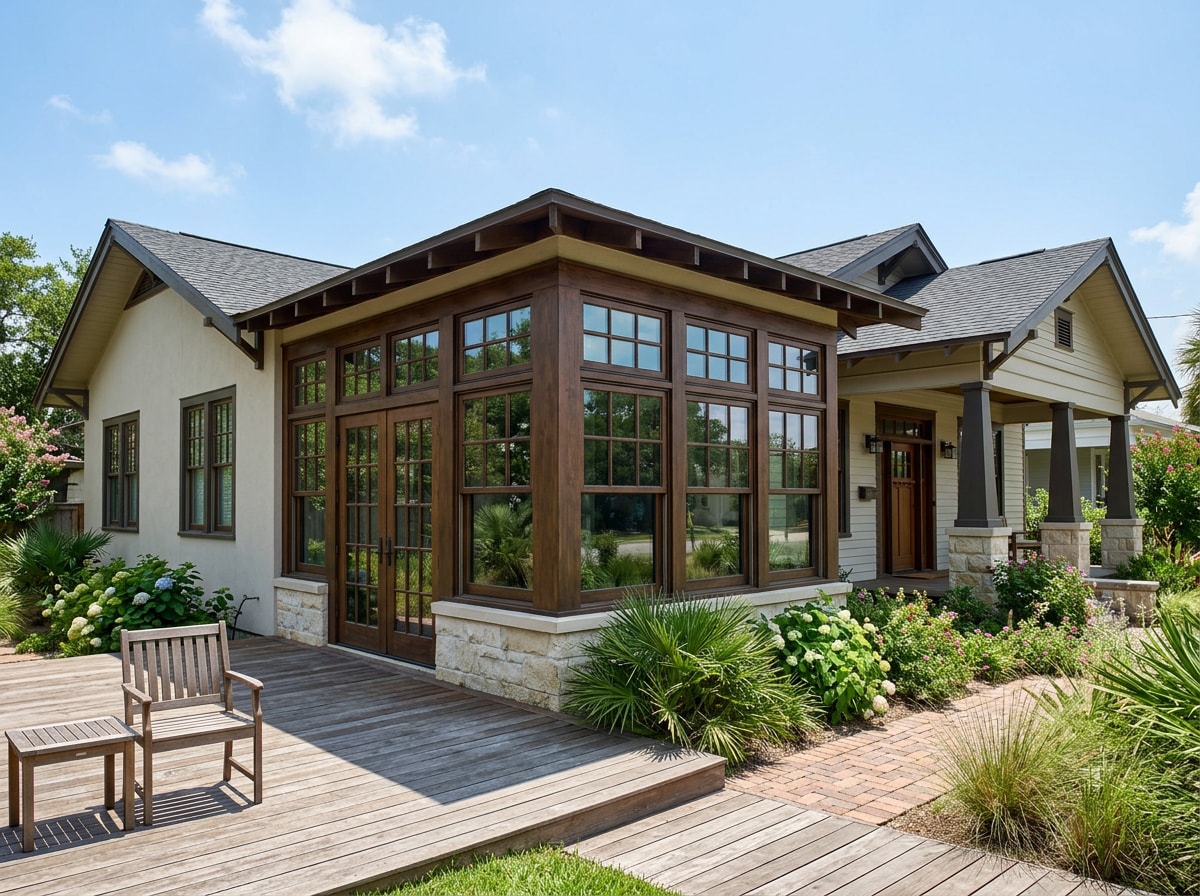
Craftsman-style sunrooms translate well to Texas Gulf Coast homes when adapted with lighter, heat-reflective finishes instead of the heavier wood tones common in cooler climates. Tapered columns, exposed rafter tails, and divided-light glass panels still read as Craftsman, but paired with insulated glazing they hold up better against Gulf humidity and sun exposure.
This style works particularly well on one-story ranch and bungalow homes common in and around Portland, TX, where the extension can echo the home's existing roofline.
How to Build a Sunroom Addition
The construction process generally follows a consistent sequence, though timelines vary by project size and permitting backlog.
- Consultation — Discuss goals, budget, and general layout with a builder.
- Site evaluation — Assess soil, drainage, and structural tie-in points for the addition.
- Design — Finalize dimensions, roofline, and glass configuration.
- Material selection — Choose glass type, framing, and finishes suited to coastal conditions.
- Permitting — Submit plans for local building permit and windstorm certification approval before construction begins.
- Construction — Build the foundation, frame, glazing, and finish work in sequence.
Most straightforward projects move from consultation to completed construction within two to four months, though wind-rated glass and custom engineering can extend that timeline. Ready to start? Get a free estimate to get a project-specific quote for your home.
FAQ
Here are the questions Gulf Coast homeowners ask most often before committing to a glass room project.
Are Glass Rooms Built to Windstorm Requirements in Portland, TX?
Yes. Portland sits in San Patricio County, one of the state's 14 designated coastal catastrophe counties, so additions generally fall under Texas windstorm rules. The windstorm inspection requirement dates back to a 1987 Texas Legislature law aimed at mitigating hurricane losses along the Gulf Coast, and the Texas Department of Insurance has administered the inspection process since January 1, 1988 . Confirm WPI-8 certification requirements with your builder and your local permitting office before construction begins.
Do Glass Rooms Use Double-Pane Insulated Glass?
Most quality glass room builds use double-pane glass to improve energy efficiency and reduce heat transfer, which matters significantly in Gulf Coast summers. ENERGY STAR certified windows, doors, and skylights are independently tested, certified, and verified by the National Fenestration Rating Council, with ratings that meet energy efficiency guidelines set by the EPA , which is a useful benchmark when comparing glass packages.
Can a Glass Room Be Added to an Existing Patio?
Sometimes, though it depends on the patio's condition. Builders typically perform a slab evaluation to confirm the existing foundation can support the new structure's weight and glazing before approving a patio enclosure conversion. Many existing slabs need extra footings added before they can carry full glass walls.
Do You Offer Vinyl Window Enclosures?
Many builders offer vinyl window enclosure systems as a budget-friendly option for homeowners who want a simpler patio enclosure without the cost of a full glass-wall build. It's a reasonable middle step between an open patio and a complete glass room.
Does a Sunroom Need a Permit?
In most cases, yes. A sunroom permit is typically required whenever an addition changes your home's structure, electrical, or HVAC systems. Building without one can create problems during resale inspections and may conflict with Portland, TX building codes, so confirm requirements with your local permitting office before construction starts.
How Long Does a Glass Room Addition Take to Build?
Most straightforward projects take two to four months from consultation to completed construction. Wind-rated glass, custom engineering, and windstorm certification can extend that timeline, especially during busy permitting seasons.
Does a Glass Room Addition Add Resale Value?
Generally, yes. A permitted, climate-controlled glass room counts as finished living space on an appraisal, which typically adds more resale value than an open-air patio or screened porch. Exact recoup percentages vary by market and sunroom type, so a local appraiser is the best source for a number specific to your home.
Ready to see what a glass room extension would cost for your home? Request your free estimate and we'll walk the site, check your slab and wind zone, and put together a project-specific plan. You can also browse our full range of remodeling services on the Revitalizing Renovations homepage.